
Car Emergency Kit Items Every Driver Needs in UAE
Driving in the UAE can involve long journeys, busy highways, high temperatures, and unexpected roadside problems. A well-prepared car emergency kit helps drivers respond more calmly when a tyre goes flat, the battery fails, or the vehicle stops working far from home.
Every driver should consider carrying basic safety equipment, a first aid kit, a reliable torch, a phone charger, and suitable tyre tools. In the UAE, it is also important to store supplies carefully because extreme cabin temperatures can damage certain items or make them unsafe to leave inside a parked vehicle.
In this article, Scrap My Car UAE explains what to include in a car emergency kit, which essential car safety equipment UAE drivers should consider, how to prepare for a car breakdown in UAE, and when recurring vehicle problems may require professional attention.
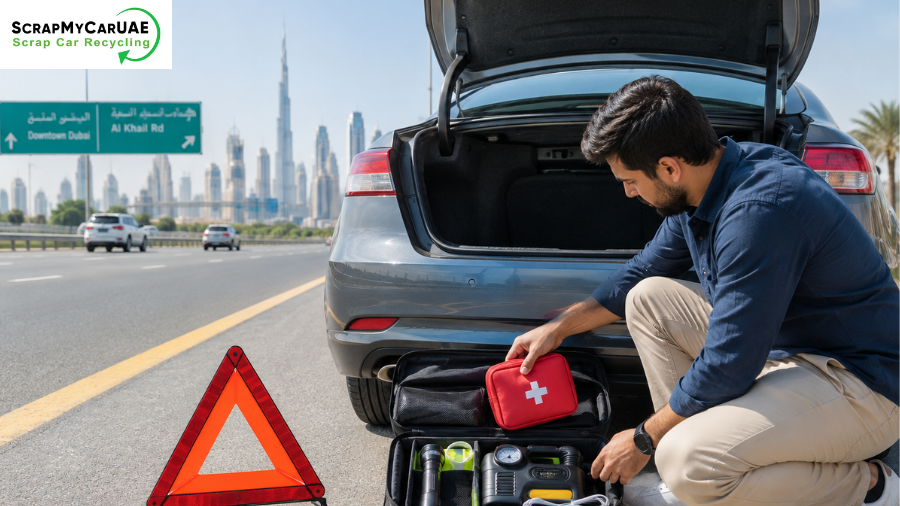
1. What Should a Car Emergency Kit Contain?
A useful car emergency kit contains items that help you remain visible, contact assistance, manage minor problems safely, and deal with unexpected delays. The exact contents depend on your vehicle, driving habits, journey length, and the conditions in which you travel.
Start with the following essentials:
A well-stocked first aid kit.
A reflective warning triangle.
A reliable torch with spare batteries, or a rechargeable model.
A mobile phone charging cable and a compatible power bank.
A pair of protective work gloves.
A tyre-pressure gauge.
A portable tyre inflator suitable for your vehicle.
A basic tool kit for simple, safe tasks.
A bottle of drinking water for immediate use.
Emergency contact details and roadside assistance information.
A high-visibility vest, preferably stored where it can be reached without searching through the boot.
These items serve different purposes. The first aid kit can help with minor injuries, the torch improves visibility after dark, and the phone charger helps you contact assistance if the vehicle becomes immobilised.
A warning triangle and high-visibility clothing can also help make a stopped vehicle more noticeable. However, never put yourself in danger to place warning equipment near moving traffic. Follow police instructions and use equipment only when it is safe to do so.
The UAE's official road-safety guidance and Abu Dhabi Police's vehicle safety advice support the importance of vehicle maintenance and carrying suitable safety equipment, including first aid and fire-safety supplies.
2. Essential Car Safety Equipment UAE Drivers Should Carry
Your emergency kit should include more than items for repairing a minor fault. Some equipment is intended to help you avoid danger while waiting for professional assistance.
First Aid Kit
A first aid kit is useful for minor cuts, scrapes, and other small injuries that may occur during a journey. Choose a kit with clearly labelled contents and check that sterile items and any products with expiry dates remain usable.
Keep the kit accessible rather than buried beneath luggage. Familiarise yourself with its contents before an emergency occurs.
First aid supplies are not a replacement for medical treatment. If someone has a serious injury or requires urgent medical attention, call the appropriate emergency service.
Reflective Warning Triangle and High-Visibility Vest
A reflective warning triangle can alert approaching drivers to a stationary vehicle, while a high-visibility vest can make you more visible when conditions are dark or visibility is poor.
Store these items where they can be accessed easily. If you need to leave the vehicle, assess the traffic and surroundings first. Avoid walking into a live lane or standing directly behind a vehicle where another driver may not see you.
If the location is unsafe, remain in the safest available position and contact the relevant authorities or roadside assistance.
Torch and Mobile Phone Charger
A torch is useful when checking the immediate surroundings after dark or locating items inside the vehicle. A phone charger and compatible power bank can help keep your phone operational while you arrange assistance.
Check that rechargeable equipment works correctly. Batteries and electronic devices should be stored according to the manufacturer's temperature recommendations, particularly during the UAE summer.
Fire Extinguisher
A suitable vehicle fire extinguisher may be a useful safety item. Choose one appropriate for vehicle use and follow its installation, inspection, and storage instructions.
Abu Dhabi Police and Civil Defence have advised drivers to maintain vehicle safety equipment and keep a fire extinguisher and first aid kit in the vehicle. See the official vehicle safety advice.
If smoke or flames appear, prioritise getting everyone away from the vehicle and calling Civil Defence on 997. Do not attempt to fight a fire if doing so would put you at risk, and never open the bonnet of a vehicle with a suspected engine fire.
Check current local requirements separately rather than assuming every item in a recommended emergency kit is legally mandatory for every private vehicle.
3. Car Emergency Kit Essentials for UAE Heat
The UAE's hot climate makes heat management an important part of vehicle preparation. High cabin temperatures can affect drinking water, medicines, electronics, batteries, and other stored supplies.
Drinking Water and Heat Protection
Keep drinking water available for immediate use, particularly when travelling longer distances. However, do not assume that bottles left in a hot vehicle will remain in ideal condition indefinitely. Inspect stored supplies and replace them when necessary.
A sun hat and sun protection can be useful if you need to wait outside the vehicle, but your priority should always be finding a safe location away from moving traffic and arranging help.
Avoid unnecessary exposure to direct sunlight while waiting for assistance. If the vehicle is safely parked away from traffic and there is no smoke, fire, or other immediate hazard, use your judgment to determine the safest place to wait.
Be Careful About What You Leave Inside a Hot Car
Not every emergency item should remain in a parked vehicle throughout the summer.
Avoid leaving heat-sensitive medicines, aerosol cans, lighters, perfumes, and other products that may become hazardous in high temperatures inside the car. Batteries and power banks also require care because excessive heat can damage them and increase safety risks.
In a report published on 20 June 2026, Al Etihad covered Abu Dhabi Police's warning against leaving certain flammable or heat-sensitive materials inside vehicles during summer. The warning included aerosol containers, batteries and energy-storage devices, perfumes, hand sanitisers, gas cylinders, and lighters. Read the summer vehicle-safety report.
Check the manufacturer's instructions for each item and remove unsuitable supplies when leaving your vehicle parked in extreme heat.
Prepare Your Car Before Long Journeys
An emergency kit cannot compensate for poor vehicle maintenance. Before travelling a long distance, check the tyre condition and pressure, engine oil where appropriate, coolant system, lights, brakes, and air conditioning.
If your vehicle has a warning light, a history of overheating, or an unresolved mechanical fault, have it inspected before setting off.
A few preventive checks may help identify problems before they become roadside emergencies.
4. What to Keep in Your Car for a Breakdown in UAE

A car breakdown in UAE can happen because of a flat tyre, a weak battery, overheating, an electrical fault, or a mechanical failure. The most useful items are those that help you remain safe and contact the right assistance.
Keep the following information and equipment available:
Your roadside assistance provider's contact details.
Your vehicle registration and insurance information, as appropriate.
A charged mobile phone.
A warning triangle and high-visibility vest.
A torch for poor-light conditions.
A tyre inflator and pressure gauge, if suitable for your vehicle.
Your vehicle's owner manual or a digital copy.
A basic description of your car, including its colour, registration details, and location.
If your vehicle stops on a highway, do not focus on repairing it before assessing the danger. Switch on the hazard lights, move to a safer position if you can do so without creating further risk, and contact roadside assistance.
If the vehicle is on fire, someone is seriously injured, or there is an immediate danger, contact the relevant emergency service.
The official UAE government portal lists these emergency numbers:
Emergency service | Number |
Police | 999 |
Ambulance | 998 |
Civil Defence / Fire | 997 |
These are emergency contacts, not substitutes for routine roadside assistance. For an ordinary breakdown without an immediate threat, contact your assistance provider or a suitable recovery service.
5. Tyre and Battery Emergency Tools Every Driver Should Consider
Tyre and battery problems are among the reasons a driver may need roadside help. The correct tools can help you identify a problem or carry out a simple task when conditions are safe, but not every repair should be attempted at the roadside.
Tyre-Pressure Gauge and Portable Inflator
A tyre-pressure gauge helps you check whether your tyres are inflated to the vehicle manufacturer's recommended pressure. A portable inflator can be useful if a tyre needs air and the tyre itself is otherwise safe to use.
Check tyre pressure when the tyres are cold where possible, and use the pressure specifications provided by the vehicle manufacturer. Do not rely solely on the maximum pressure printed on the tyre sidewall.
An inflator will not safely repair every puncture. If the tyre is visibly damaged, has a sidewall puncture, or cannot maintain pressure, arrange professional assistance rather than continuing to drive on it.
Spare Tyre and Basic Tools
If your vehicle is equipped with a spare tyre, check that it is in usable condition and that the necessary tools are present. Some vehicles instead use a temporary repair kit or another manufacturer-approved solution.
If you need to change a tyre, do so only on stable ground in a location well away from moving traffic. Never attempt to jack up a vehicle on an unsafe shoulder or while it is exposed to passing vehicles.
When the location is dangerous, call for recovery instead.
Jump Leads or a Compatible Jump Starter
Jump leads or a portable jump starter may help when a compatible vehicle has a discharged battery. However, modern vehicles can have specific electrical-system requirements, and connecting equipment incorrectly can cause damage or injury.
Read the vehicle manual and follow the jump starter manufacturer's instructions. Do not attempt a jump-start if the battery is visibly damaged, leaking, swollen, or otherwise unsafe.
If you are uncertain, ask for professional assistance.
6. How to Maintain and Store Your Car Emergency Kit
Buying the equipment is only the first step. A car emergency kit is useful only when its contents are present, accessible, and in working condition.
Review your kit periodically and before longer journeys. Check the following:
First aid supplies: Replace expired or damaged products and replenish anything that has been used.
Torch and electronic equipment: Test the torch, inspect its batteries, and charge compatible devices according to their instructions.
Tyre equipment: Check that the inflator operates correctly and that the gauge is usable. Inspect the spare tyre and tools if your vehicle carries them.
Warning equipment: Make sure the reflective triangle is intact and can be deployed correctly.
Emergency contacts: Keep roadside assistance details current and ensure you know how to share your location.
Heat-sensitive supplies: Remove unsuitable products from the vehicle and replace any supplies that have deteriorated.
Organise the items in a secure storage bag or compartment so they do not roll around or interfere with driving. Keep heavier tools secured, and do not store equipment where it could obstruct the pedals, driver's visibility, or access to essential controls.
7. What Should You Do During a Car Breakdown in UAE?
If your car breaks down, follow a safety-first approach rather than attempting to diagnose every problem immediately.
Step 1: Stop in the Safest Available Place
If the vehicle is still controllable, move away from moving traffic when it is safe to do so. Switch on the hazard lights and stop in an appropriate location.
Do not make sudden manoeuvres or attempt to continue driving if the vehicle has a serious fault that makes it unsafe.
Step 2: Assess the Situation Before Leaving the Vehicle
Check for immediate dangers such as smoke, fire, traffic exposure, or an unsafe stopping location. If you suspect a vehicle fire, get everyone away from the car and contact Civil Defence.
If the car is stopped in a dangerous location, do not walk around it or attempt roadside repairs merely to use the emergency kit.
Step 3: Contact the Appropriate Assistance
For an ordinary mechanical breakdown, contact your roadside assistance provider or recovery service. Share your location clearly and explain the problem, including whether the vehicle is blocking traffic or has passengers who need help.
For an accident or immediate danger, contact the relevant emergency service and follow the operator's instructions.
Step 4: Avoid Risky Repairs
Do not open a hot radiator cap, work beneath a vehicle supported only by a jack, or attempt electrical repairs in an unsafe location.
If the engine overheats, stop driving as soon as it is safe to do so and let the vehicle cool. Do not open the cooling system while it is hot, because pressurised coolant can cause serious burns. Arrange professional assistance if the cause is unclear or the problem persists.
Step 5: Wait in the Safest Available Location
Keep your phone available and follow the instructions of the relevant authority or recovery provider. Avoid standing in front of or behind the vehicle where passing traffic could put you at risk.
The aim of an emergency kit is to support safer decisions while help is arranged, not to encourage repairs in dangerous conditions.
8. When Repeated Breakdowns Mean You Should Reassess Your Car
An emergency kit is useful for unexpected problems, but repeated breakdowns may indicate that your vehicle needs a more thorough mechanical assessment.
Warning signs include recurring overheating, repeated battery failures, transmission problems, persistent warning lights, unexplained fluid leaks, and repairs that fail to resolve the same issue.
Have a qualified mechanic assess the vehicle and explain the likely repair costs. Compare those costs with the car's current value, age, condition, and expected reliability.
Should You Repair, Sell, or Scrap the Vehicle?
The right decision depends on the nature of the problem and the financial implications.
Repair the car if the fault is manageable and the repair makes sense compared with the vehicle's value and expected use.
Sell the car if it still has reasonable resale value and you can find a buyer on acceptable terms.
Consider scrapping the car if major faults, extensive damage, or repeated repair costs make continued ownership uneconomical.
A single breakdown does not mean that a car should be scrapped. The decision should follow an assessment of the vehicle and the available offers.
For owners of old, damaged, or non-running vehicles, Scrap My Car UAE offers a way to request a valuation and explore whether selling the vehicle for scrap is a practical alternative.
9. How Scrap My Car UAE Can Help With an Unwanted Vehicle
Scrap My Car UAE buys vehicles in different conditions, including old cars, accident-damaged vehicles, and cars with mechanical or electrical problems. The company advertises vehicle valuations and free collection across the UAE.
If your car has become unreliable or its repair costs are difficult to justify, you can request a valuation and compare the offer with the estimated cost of keeping or repairing the vehicle.
The process starts with sharing details such as the vehicle's make, model, year, location, and current condition. Be honest about major faults or whether the car is no longer running so the company can assess the vehicle appropriately.
Before accepting an offer, confirm the final price, collection arrangements, payment terms, and the paperwork needed for the specific vehicle. Vehicle collection and payment do not necessarily complete every official registration or deregistration requirement, so clarify the applicable process.
You can visit the Scrap My Car UAE website or contact the team directly for further information.
10. Car Emergency Kit Checklist for UAE Drivers
Use this checklist to prepare your vehicle before daily commuting or a longer road trip.
Safety and visibility
Reflective warning triangle
High-visibility vest
Reliable torch
Suitable vehicle fire extinguisher
Protective gloves
First aid and communication
First aid kit
Mobile phone and charging cable
Compatible power bank stored safely
Roadside assistance contact details
Emergency contact numbers
Tyre and vehicle tools
Tyre-pressure gauge
Portable tyre inflator suitable for your vehicle
Spare tyre or manufacturer-approved puncture solution, if applicable
Basic tool kit
Jump leads or compatible jump starter, if suitable for your vehicle
Owner manual or accessible digital copy
UAE heat and travel preparation
Drinking water for immediate use
Sun protection for use when appropriate
Checked and usable emergency supplies
Tyres, lights, brakes, and other key vehicle systems inspected before long journeys
Check the condition and suitability of each item, especially before summer travel. Avoid leaving products inside the vehicle if the manufacturer warns against exposure to high temperatures.
Frequently Asked Questions About Car Emergency Kits in UAE
1. What is the most important item in a car emergency kit?
There is no single item that covers every emergency. A charged phone, reflective warning equipment, a first aid kit, and access to roadside assistance are useful starting points. The best kit depends on your vehicle and typical journeys.
2. Should every driver in the UAE carry a first aid kit?
A first aid kit is a sensible safety item for private drivers. Abu Dhabi Police and Civil Defence have also recommended carrying first aid supplies as part of vehicle safety preparation. Check current local requirements if you need to establish whether a particular item is legally mandatory for your vehicle.
3. What should I do if my car breaks down in extreme heat?
Stop in the safest available place, switch on the hazard lights, and contact roadside assistance. Avoid unnecessary exposure to direct sunlight and do not attempt repairs that could expose you to hot engine components or moving traffic. If there is a fire or immediate danger, contact the relevant emergency service.
4. Should I keep a tyre inflator and jump starter in my car?
They can be useful if they are compatible with your vehicle and stored according to the manufacturer's instructions. Learn how to use them safely before an emergency occurs. If the tyre or battery is damaged, or you are unsure about the correct procedure, seek professional assistance.
5. How often should I check my car emergency kit?
Inspect it periodically and before long journeys. Check first aid supplies, expiry dates, torch batteries, electronic equipment, tyre tools, and emergency contact details. In the UAE, also review any heat-sensitive items and remove products that are unsuitable for storage in a hot vehicle.
6. What emergency numbers should UAE drivers know?
The UAE government's published emergency contacts include 999 for police, 998 for ambulance, and 997 for Civil Defence. For an ordinary breakdown without an immediate danger, contact your roadside assistance or recovery provider.
7. What should I do if my car keeps breaking down?
Arrange a professional inspection to identify the underlying fault and obtain a repair estimate. Compare the cost of repairs with the vehicle's current value and expected reliability. If the car is old, heavily damaged, or uneconomical to repair, you may also want to compare offers to sell or scrap it.
8. Can Scrap My Car UAE buy a non-running or damaged car?
Scrap My Car UAE advertises purchases of vehicles in different conditions, including damaged and non-running cars. Contact the company with your vehicle details to request a valuation and confirm collection, payment, and paperwork arrangements.
Final Thoughts
A well-prepared car emergency kit helps UAE drivers respond more safely to unexpected roadside problems. First aid supplies, reflective warning equipment, a torch, a phone charger, and suitable tyre tools are useful essentials, while heat-conscious storage and regular vehicle maintenance are particularly important in the UAE.
Remember that equipment alone cannot prevent every breakdown. Check your vehicle before longer journeys, take warning signs seriously, and avoid risky roadside repairs when professional help is the safer option.
If your car has become unreliable and repeated repairs are no longer practical, consider comparing the cost of keeping it with the available selling or scrapping options.
Contact Scrap My Car UAE Today
If you own an old, damaged, or non-running car and want to explore your options, contact Scrap My Car UAE for a vehicle valuation.
Call or WhatsApp: 055 745 83 22
Website: www.scrapmycaruae.com
Free vehicle collection: Advertised across the UAE; confirm the arrangements for your vehicle when requesting a quote.
Scrap My Car UAE can help you explore a practical option for an unwanted vehicle while you focus on keeping your next journey safer.


