



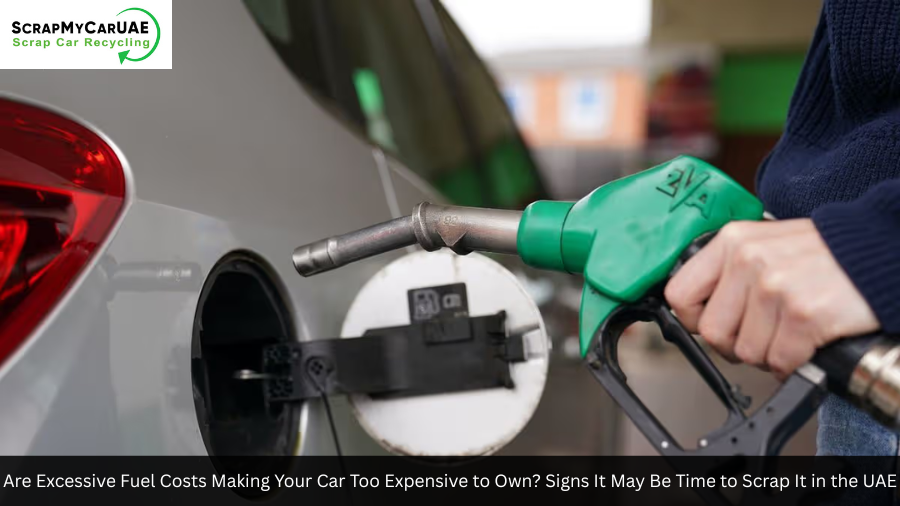
Fuel is one of the biggest ongoing expenses for UAE vehicle owners. While some increase in fuel consumption is normal as a vehicle gets older, a sudden or continuous rise in fuel usage can indicate deeper mechanical problems.
For drivers dealing with excessive fuel costs, the problem can become even more expensive when higher fuel bills are combined with frequent repairs, poor performance, rising maintenance expenses, and declining vehicle value.
In the UAE, high temperatures, heavy traffic, long-distance driving, and extensive use of air conditioning can all affect fuel efficiency. However, when a vehicle's fuel consumption continues to worsen despite regular maintenance, it may be time to reconsider whether keeping the car is financially worthwhile.
In this guide, Scrap My Car UAE explains what causes excessive fuel consumption, how rising fuel costs affect your overall ownership expenses, and the signs that may indicate it is time to sell or scrap your vehicle.
🚗 Why Fuel Consumption Increases as Cars Get Older
Every vehicle experiences wear and tear over time. As mileage increases, various mechanical and electrical components can become less efficient.
Common causes of increasing fuel consumption include:
Engine wear
Dirty or clogged air filters
Faulty oxygen sensors
Worn spark plugs
Tire pressure problems
Fuel injector issues
Transmission problems
Poor wheel alignment
Brake drag
Cooling system problems
Aging sensors and electronic components
A small drop in fuel efficiency may not seem serious initially. However, when fuel consumption continues increasing month after month, the additional expense can become substantial.
⛽ 1. Your Fuel Bills Keep Increasing
One of the clearest signs of excessive fuel costs is a noticeable increase in how much you spend at the fuel station.
If you used to fill your tank once a week but now need to refuel several times, there may be an underlying mechanical problem.
Higher fuel expenses may result from:
Reduced engine efficiency
Increased fuel consumption
Frequent short-distance driving
Heavy traffic
Engine performance problems
Poor tire pressure
Aging vehicle components
If your fuel bills continue rising despite similar driving habits, have the vehicle inspected before assuming the problem is simply higher fuel usage.
🔧 2. Your Engine Is No Longer Running Efficiently
A properly maintained engine should operate smoothly and efficiently.
Signs of declining engine efficiency include:
Rough idling
Slow acceleration
Engine hesitation
Frequent stalling
Poor throttle response
Difficulty maintaining speed
Unusual engine noises
When the engine has internal wear or fuel-delivery problems, it may require more fuel to produce the same level of performance.
Over time, this can contribute significantly to excessive fuel costs.
⚠️ 3. The Check Engine Light Keeps Appearing
A recurring check engine light should never be ignored.
Potential causes include:
Faulty oxygen sensors
Fuel injector problems
Mass airflow sensor issues
Ignition problems
Emissions system faults
Engine misfires
Catalytic converter problems
Some of these problems can reduce fuel efficiency considerably.
Ignoring the warning may also allow a relatively manageable repair to develop into a much more expensive mechanical problem.
🛞 4. Your Tires Are Wearing Unevenly
Tire condition can have a surprising effect on fuel consumption.
Underinflated tires create greater rolling resistance, which forces the engine to work harder.
Other tire-related problems include:
Incorrect tire pressure
Poor wheel alignment
Uneven tire wear
Incorrect tire size
Damaged tires
Regularly checking tire pressure and alignment can help maintain better fuel efficiency.
However, if poor fuel economy continues despite correcting these issues, a deeper mechanical problem may be involved.
❄️ 5. Your Car's AC System Is Working Too Hard
Air conditioning is essential for comfortable driving in the UAE.
During hot weather, drivers rely heavily on their AC systems. A poorly maintained system may place additional load on the engine.
Potential problems include:
Weak cooling
Compressor issues
Blocked condenser
Refrigerant problems
Faulty AC components
While using the AC naturally affects fuel consumption, a poorly functioning system can make the situation worse.
If your vehicle has both declining fuel economy and expensive AC repairs, continuing to invest in an aging vehicle may not always make financial sense.
⚙️ 6. Transmission Problems Are Increasing Fuel Consumption
The transmission plays an important role in keeping the engine operating efficiently.
A failing transmission may cause:
Delayed gear changes
Gear slipping
High engine RPM
Jerking during acceleration
Difficulty changing gears
Transmission overheating
When the transmission cannot select or maintain the appropriate gear efficiently, the engine may consume more fuel.
If transmission repairs are becoming frequent while excessive fuel costs continue to increase, it may be worth comparing the cost of keeping the vehicle with its current market value.
🛑 7. Your Brakes May Be Dragging
Brake problems don't always appear as obvious braking failures.
A sticking brake caliper or other brake issue can create resistance while the vehicle is moving.
Possible signs include:
Vehicle pulling to one side
Burning smell near a wheel
Excessive brake heat
Uneven brake pad wear
Reduced acceleration
Increased fuel consumption
If you suspect a brake problem, have it inspected promptly because brake-related issues can affect both fuel economy and driving safety.
🌡️ 8. Extreme UAE Heat Can Affect Vehicle Efficiency
The UAE climate creates additional challenges for vehicle owners.
High temperatures can affect:
Engine fluids
Batteries
Tires
Cooling systems
Air conditioning
Electrical components
Heavy AC use and high ambient temperatures can naturally increase fuel consumption.
However, if fuel efficiency has deteriorated significantly compared with previous years, climate alone may not explain the problem.
An aging vehicle may require increasingly expensive repairs to maintain acceptable fuel economy.
💰 How Excessive Fuel Costs Affect Your Total Ownership Expenses
Fuel is only one part of the cost of owning a vehicle.
When an aging car develops poor fuel efficiency, you may also face:
Higher maintenance costs
More frequent servicing
Expensive replacement parts
Increased repair bills
Towing expenses
Reduced resale value
More frequent breakdowns
For example, a vehicle that is cheap to purchase may become expensive to own if it requires constant repairs and consumes significantly more fuel than newer alternatives.
This is why vehicle owners should consider total ownership cost, rather than looking only at the car's purchase price.
📉 9. Your Car Is Losing Value While Fuel Costs Rise
A major concern for owners of older vehicles is the combination of depreciation and increasing running costs.
An aging vehicle may simultaneously experience:
Lower resale value
Higher fuel consumption
More frequent repairs
Increasing maintenance costs
Reduced reliability
Lower buyer demand
At some point, continuing to spend money on the vehicle may provide little financial benefit.
If your car is worth only a small amount but requires thousands of dirhams each year in fuel and repairs, scrapping may be a more practical option.
🚦 When Should You Consider Scrapping Your Car?
Consider selling or scrapping your vehicle if several of the following apply:
✅ Fuel consumption has increased significantly
✅ Fuel bills are becoming difficult to manage
✅ Major engine repairs are required
✅ Transmission problems are becoming frequent
✅ The car repeatedly breaks down
✅ Repair expenses exceed the vehicle's market value
✅ The vehicle repeatedly fails inspections
✅ The car has high mileage and declining reliability
✅ Multiple systems require expensive repairs
✅ The vehicle has become difficult to sell privately
There is no single mileage or age at which every vehicle should be scrapped. The better approach is to compare the vehicle's remaining value with its expected future expenses.
♻️ Why Scrapping Can Be a Smarter Financial Decision
If your vehicle has become too expensive to operate, scrapping can help you stop the cycle of rising expenses.
Selling your unwanted vehicle for scrap can help you:
Receive cash for an aging vehicle
Avoid future repair expenses
Reduce ongoing fuel costs
Eliminate storage expenses
Avoid repeated workshop visits
Free up parking space
Recover value from reusable parts and recyclable materials
Even a vehicle with serious mechanical problems can still contain valuable components and recyclable metals.
🏢 Why Choose Scrap My Car UAE?
At Scrap My Car UAE, we make selling or scrapping unwanted vehicles simple, fast, and hassle-free.
Our services include:
✅ Free vehicle valuation
✅ Competitive offers
✅ Instant cash payment
✅ Free vehicle pickup anywhere in the UAE
✅ Assistance with paperwork and deregistration
✅ Environmentally responsible recycling
✅ Vehicles accepted in various conditions
Whether your vehicle has high mileage, poor fuel economy, engine problems, transmission issues, accident damage, or is completely non-running, our team can help you explore your options.
📋 How to Scrap Your Car with Scrap My Car UAE
Step 1: Request a Free Quote
Provide basic information about your vehicle, including:
Make
Model
Year
Condition
Location
Step 2: Receive a Vehicle Valuation
Your vehicle's value can depend on its condition, reusable components, metal content, model, and current market conditions.
Step 3: Arrange Free Vehicle Collection
If the vehicle is no longer practical or safe to drive, free pickup can make the process easier.
Vehicles can be collected from locations such as:
Homes
Workshops
Offices
Parking areas
Roadside locations
Step 4: Receive Payment
Once the vehicle details and condition are verified, payment is made according to the agreed offer.
Step 5: Complete the Necessary Paperwork
Scrap My Car UAE assists with the relevant paperwork and deregistration process so the transaction can be completed smoothly.
❓ Frequently Asked Questions About Excessive Fuel Costs
1. Why is my car suddenly using more fuel?
Sudden increases in fuel consumption can be caused by problems such as low tire pressure, clogged air filters, faulty sensors, worn spark plugs, fuel injector issues, transmission problems, or engine faults. Driving conditions and heavy AC use can also affect fuel economy.
2. Can an old car cause excessive fuel costs?
Yes. As vehicles age, engine, transmission, fuel-system, and electrical components can become less efficient. Increased maintenance requirements combined with declining fuel economy can make an older vehicle increasingly expensive to operate.
3. How can I reduce my car's fuel consumption?
Regular servicing, correct tire pressure, timely replacement of worn components, proper wheel alignment, avoiding unnecessary idling, and maintaining the engine and transmission can help improve fuel efficiency.
4. Does using AC increase fuel consumption in the UAE?
Yes. Air conditioning places an additional load on the vehicle, and extensive AC use during very hot weather can increase fuel consumption. However, unusually poor fuel economy should not automatically be attributed to AC use; mechanical problems may also be responsible.
5. When is high fuel consumption a sign of a serious problem?
If fuel consumption suddenly changes, continues worsening, or is accompanied by warning lights, poor acceleration, rough idling, unusual smells, smoke, or frequent breakdowns, the vehicle should be inspected by a qualified professional.
6. Is it cheaper to repair a fuel-inefficient car or scrap it?
It depends on the vehicle's age, condition, market value, and repair requirements. If fixing the underlying problem costs a reasonable amount and restores the vehicle's efficiency, repair may make sense. If the car already has multiple expensive problems and low resale value, scrapping may be financially smarter.
7. Can I scrap a car that has poor fuel economy but still runs?
Yes. A vehicle does not necessarily have to be completely non-running to have scrap value. Its condition, reusable parts, weight, model, and recyclable materials can all contribute to its value.
8. Does excessive fuel consumption reduce a car's resale value?
It can. Buyers generally prefer vehicles with reasonable running costs. If poor fuel economy is caused by unresolved mechanical problems, buyers may offer less because they anticipate future repair and operating expenses.
9. What should I do if my old car is becoming too expensive to maintain?
Start by calculating your total annual ownership costs, including fuel, repairs, servicing, insurance, registration, and other expenses. Compare these costs with the vehicle's current value and expected future reliability. If keeping the vehicle no longer makes financial sense, obtaining a scrap valuation can help you determine your next step.
🏁 Final Thoughts
Excessive fuel costs can be more than just an inconvenience. When rising fuel consumption is combined with frequent repairs, declining performance, transmission problems, warning lights, and falling resale value, your vehicle may have become too expensive to keep.
Rather than continuing to spend money on a car that is becoming increasingly costly to operate, consider whether selling or scrapping it could be the more practical financial decision.
Scrap My Car UAE provides a simple way to turn unwanted, damaged, aging, or non-running vehicles into cash, with vehicle valuation, pickup, payment, and paperwork assistance.
📞 Contact Scrap My Car UAE Today
📞 Call or WhatsApp: 055 745 83 22
🌐 Visit: scrapmycaruae.com
Don't let excessive fuel costs and rising repair bills drain your budget. Turn your unwanted vehicle into instant cash with Scrap My Car UAE—a fast, convenient, and hassle-free option for vehicle owners across the UAE. 🚗💰