



Owning an old car in the UAE can seem like a cost-effective decision, especially when you have already paid off the vehicle. However, the purchase price is only one part of the overall cost of ownership. Regular servicing, unexpected repairs, tyre replacements, insurance, fuel and depreciation can gradually turn an inexpensive car into a costly responsibility.
The real question is not simply how much your car costs to maintain. It is whether the money you continue spending on it makes financial sense compared with its current value and the cost of replacing it.
For UAE drivers, this decision can become particularly important when an ageing vehicle develops repeated mechanical problems or requires major repairs. Understanding your old car maintenance costs can help you decide whether to keep driving, repair, sell or consider car scrapping in UAE.
In this article, Scrap My Car UAE explains how to assess the true cost of keeping an older vehicle, which expenses deserve attention and how to decide whether another repair is worthwhile.
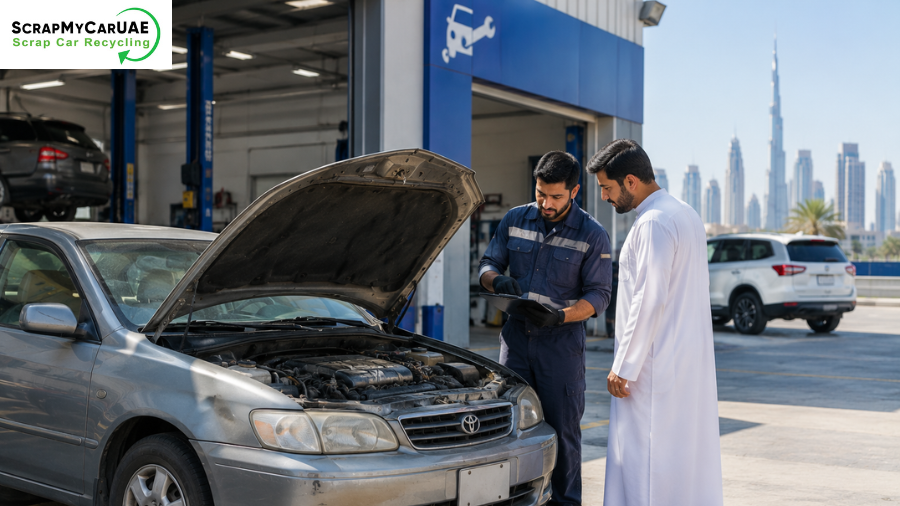
What Does It Really Cost to Keep an Old Car in the UAE?
The true cost of keeping an old car in UAE includes both predictable expenses and unexpected bills. Even when a vehicle has no monthly finance payment, you still need to account for the money required to maintain, insure, operate and eventually replace it.
Some expenses are easy to track. Fuel, insurance, routine servicing and registration-related costs appear regularly in your budget. Others are less predictable, such as a failing air-conditioning system, a damaged cooling component, transmission trouble or repeated electrical faults.
Depreciation is another important consideration. Your car may lose value as it ages, although the rate varies according to its make, model, condition, mileage, service history and market demand.
A practical way to understand the total cost is to divide your expenses into four categories:
Routine ownership costs: Servicing, oil changes, filters, tyres and other scheduled maintenance.
Unexpected repair costs: Mechanical, electrical, cooling-system, brake and air-conditioning repairs.
Running costs: Fuel, insurance, parking, tolls and applicable registration or inspection expenses.
Loss of vehicle value: The difference between what your car could sell for at the beginning and end of a chosen period.
The important point is that no single expense tells the whole story. A vehicle with relatively low annual servicing costs may still be expensive to own if it needs a major repair or has lost much of its resale value.
For a broader perspective on vehicle maintenance, Dubai's Roads and Transport Authority (RTA) recommends regular inspections and checks of tyres, fluids, brakes and air-conditioning, particularly during the summer. Its June 2026 vehicle inspection and summer tyre maintenance guidance highlights the importance of preventative checks in reducing breakdown risks.
Old Car Maintenance Costs: Where Does Your Money Go?
The maintenance costs of an older vehicle depend on its condition, usage and service history. Age does not automatically make a car unreliable, but worn components and neglected maintenance can increase the likelihood of expensive repairs.
1. Routine servicing and replacement parts
Oil changes, filters, spark plugs and other scheduled maintenance items are normal parts of vehicle ownership. Following the manufacturer's service schedule helps identify developing problems before they become more serious.
However, if your vehicle has missed several services or has been driven extensively without appropriate maintenance, you may need to address multiple issues at once.
When estimating your old car maintenance costs, review your recent service invoices rather than relying on memory. A record of expenses over the past 12 months provides a better starting point for deciding whether ownership remains affordable.
2. Cooling system and air-conditioning repairs
High summer temperatures make an effective cooling system and reliable air-conditioning particularly important for UAE drivers.
Radiator problems, coolant leaks, worn hoses, faulty fans and other cooling-system faults can affect engine operation. Air-conditioning problems can also make driving uncomfortable and may require repairs to compressors, condensers or other components.
Not every older car will develop these problems, and heat alone does not establish that a component has failed. Nevertheless, regular inspections and prompt attention to warning signs can help drivers avoid ignoring faults that may become more expensive.
3. Tyres, brakes and suspension
Tyres and brakes are essential safety components, so their condition should not be judged solely by the cost of replacement.
Older vehicles may also develop suspension wear, unusual vibrations, uneven tyre wear or steering problems. These symptoms can have several causes and should be assessed by a qualified mechanic.
The RTA's vehicle maintenance guidance recommends checking tyre pressure and condition, brake performance, engine oil, coolant and signs of fluid leaks. These checks are useful for older vehicles as well as newer ones.
4. Battery and electrical problems
Battery failure, faulty sensors, wiring problems, malfunctioning windows and other electrical faults can affect a vehicle's reliability.
One minor issue does not necessarily mean that your car is no longer worth maintaining. However, repeated electrical problems can make it difficult to predict future expenses, particularly when the underlying cause has not been properly diagnosed.
Before approving another repair, ask the workshop to explain the fault, the proposed solution and the estimated cost.
5. Repeated breakdowns and emergency expenses
A vehicle that regularly fails to start or requires roadside assistance can cost more than the workshop invoice suggests.
You may also lose time travelling to the workshop, arranging alternative transport or dealing with unexpected delays. These indirect costs are difficult to calculate precisely, but they are worth considering when comparing an older car with a more reliable alternative.
How Do Repairs and Depreciation Affect an Old Car in UAE?
Repair costs and depreciation should be considered together when deciding whether to keep an ageing vehicle.
Imagine that your car has a current market value of AED 12,000 and requires a repair costing AED 4,000. That repair represents a substantial expense relative to the car's estimated value. However, it does not automatically mean that scrapping is the better decision.
You also need to consider what the repair will achieve. Will it address a single, well-understood fault and leave the car dependable? Or is it one of several repairs likely to be needed in the near future?
The distinction matters because spending money on repairs does not normally increase a vehicle's value by the full amount spent.
For example, a car valued at AED 12,000 before a AED 4,000 repair will not necessarily be worth AED 16,000 afterwards. The resulting value depends on the vehicle's condition, market demand and the nature of the work completed.
Likewise, an old car with a low resale value may still be worth keeping if it is reliable, safe and inexpensive to maintain.
The goal is to compare the likely future cost of ownership with the practical value you expect to receive from the vehicle. Avoid making the decision based solely on the money you have already spent. Those past expenses cannot be recovered simply by continuing to own the car.
How Can You Calculate the Real Cost of Keeping Your Car?
You do not need an elaborate financial model to understand what your car is costing you. Start with your actual expenses and make a reasonable estimate of the costs you may face over the next year.
Step 1: Add up your recent ownership expenses
Review the previous 12 months and record your spending on:
Routine servicing and maintenance
Mechanical and electrical repairs
Tires, brakes and battery replacements
Fuel
Insurance and registration-related expenses
Parking, tolls and other regular driving costs
Recovery or towing, if applicable
Separate regular expenses from unusual repairs. This will help you understand whether a large bill was an isolated event or part of a recurring pattern.
Step 2: Estimate upcoming repairs
Ask your mechanic which components may require attention soon. Request a written estimate for any major work and distinguish between safety-critical repairs and items that can be scheduled later.
Do not assume that every possible future repair will happen. Instead, use the mechanic's assessment to identify the most likely expenses and uncertainties.
Step 3: Check your car's current value
Research comparable vehicles with similar specifications, mileage and condition to estimate your car's private-sale value.
Remember that advertised prices are asking prices, not proof of completed sales. Accident damage, mechanical faults, expired registration and other circumstances may affect the actual offer you receive.
If the car is damaged or no longer runs, a separate as-is or scrap valuation may help you compare your options.
Step 4: Compare the cost of keeping it with the alternatives
Consider how much you expect to spend over the next year, whether the car is likely to remain reliable and what it would cost to replace it.
A replacement vehicle also brings costs, including its purchase price, insurance, maintenance and depreciation. Scrapping your current car is therefore not automatically the cheapest option; it is one alternative to evaluate against your circumstances.
A hypothetical example: Is another repair worthwhile?
Suppose you own an older car in the UAE and receive the following estimates:
Expense or value | Illustrative amount |
Current estimated market value | AED 12,000 |
Proposed major repair | AED 4,000 |
Other expected maintenance over the next year | AED 1,500 |
Estimated total of the repair and additional maintenance | AED 5,500 |
These figures are hypothetical examples, not UAE market averages or a valuation of any particular car.
In this scenario, the repair and additional maintenance would total AED 5,500. That does not automatically make the car uneconomical to keep, but it gives the owner a reason to investigate the fault, the likelihood of further repairs and the vehicle's current value.
The next step would be to compare the cost of keeping the car with an as-is sale or scrap valuation. The owner can then make a decision using the actual condition and available offers rather than relying on the car's age alone.
Repair or Scrap Car in UAE: How Do You Decide?
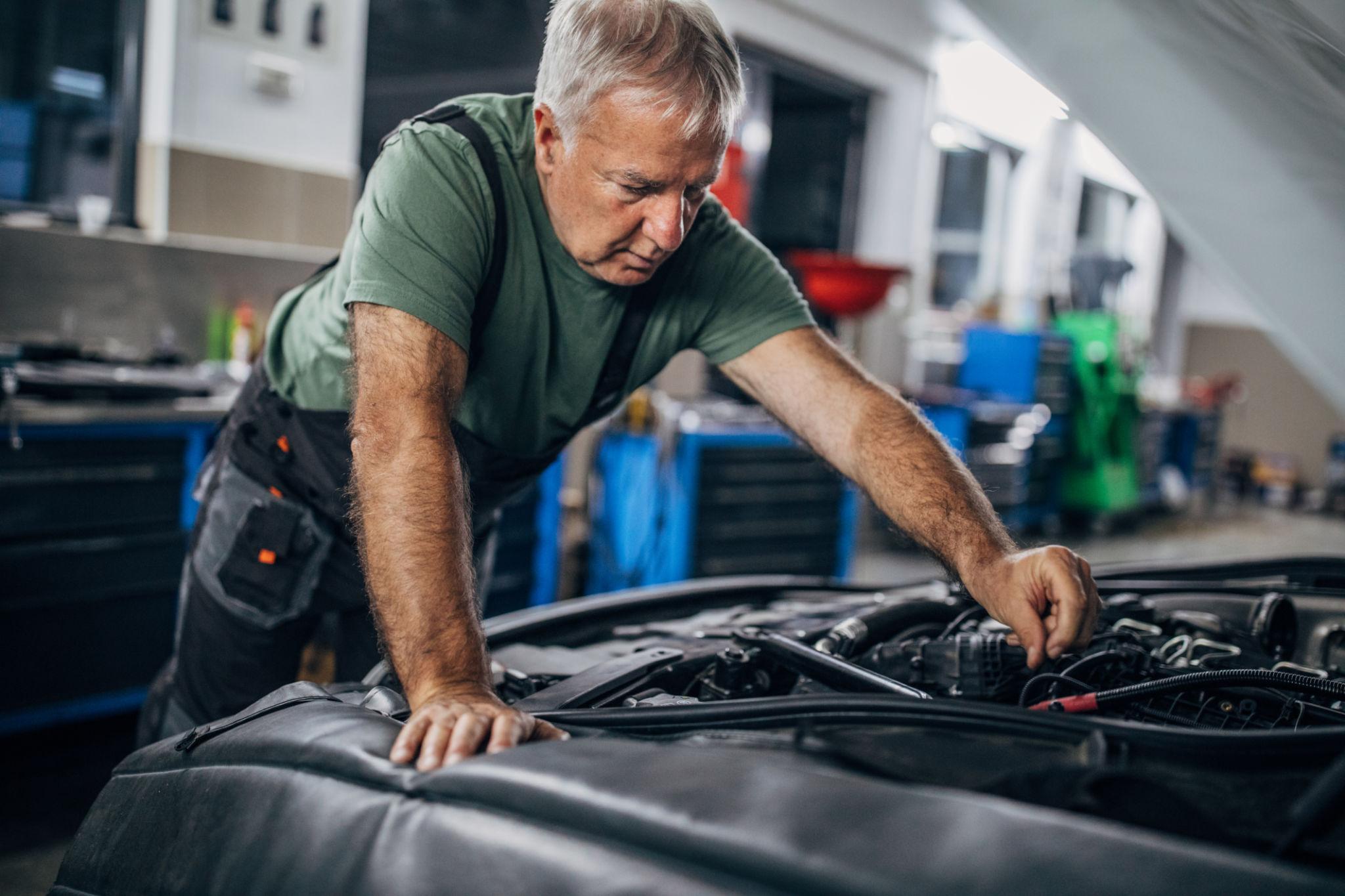
Deciding whether to repair or scrap a car in UAE requires more than comparing one repair bill with the vehicle's value. Consider the car's reliability, safety, future maintenance needs and practical usefulness.
When repairing your old car may make sense
Repairing the vehicle may be reasonable when the fault is clearly identified, the repair cost is manageable and the rest of the car remains in good condition.
For example, an older car with a reliable service history may need a straightforward repair while its engine, transmission, brakes and other major systems remain serviceable. If the vehicle continues to meet your needs, keeping it may be more practical than replacing it.
A qualified mechanic's diagnosis can help you distinguish between a repair that addresses a specific problem and one that may only be part of a larger series of repairs.
When you should consider selling or scrapping
A different decision may be appropriate if your car has repeated major faults, serious accident damage or a repair estimate that is difficult to justify relative to its value.
You may also want to explore alternatives if the car has become unreliable enough to disrupt your daily routine or if several expensive repairs are expected in a short period.
Consider obtaining a valuation before authorising another major repair. This gives you a point of comparison and helps you understand what the vehicle may be worth in its current condition.
There is no universal age, mileage figure or repair-cost percentage at which every car should be scrapped. The right decision depends on the individual vehicle and the owner's needs.
When Does Car Scrapping in UAE Make Financial Sense?
Car scrapping in UAE can be a practical option when a vehicle is no longer economical to repair, has sustained substantial damage or is no longer useful to its owner.
The first step is to understand the difference between a car's market value and its potential scrap or salvage value. A roadworthy car may have value as a complete vehicle, while a damaged or non-running car may be assessed according to its condition, potentially reusable components and the practical arrangements needed to collect it.
According to Scrap My Car UAE's scrap-car valuation information, a vehicle's make, model, year, mechanical condition, usable components and collection circumstances can all inform the assessment. There is no single fixed scrap price that applies to every car.
Before deciding to scrap your vehicle, consider the following:
Obtain an estimate for any major repair still under consideration.
Compare that estimate with the car's current market value.
Request an as-is valuation if the car is damaged or non-running.
Confirm the offer, collection arrangements and any applicable costs before agreeing to proceed.
Check the ownership, registration and handover requirements relevant to your vehicle and emirate.
If the car is still usable, compare the scrapping option with a private sale or another suitable selling route. The objective is to make an informed decision rather than automatically scrapping every older vehicle.
How Scrap My Car UAE Can Help You Assess Your Options
If your old car in UAE has become expensive to maintain, you do not necessarily need to pay for another repair before exploring its value.
Scrap My Car UAE accepts valuation requests for vehicles in different conditions, including old cars, high-mileage vehicles, accident-damaged cars and vehicles with mechanical or electrical problems. Non-running cars can also be submitted for valuation.
The process begins with your vehicle details. Share the make, model, year and current condition, along with any known faults or damage. If a workshop has already diagnosed a problem, that information may help explain the vehicle's condition.
You can then discuss the valuation and available next steps with the team. A valuation request is free and does not obligate you to accept an offer.
Free vehicle collection is available across supported UAE locations, subject to confirming the practical arrangements for your car. If the vehicle is parked in a basement, has flat tyres or cannot move, explain these details when requesting a valuation.
Before accepting an offer, confirm the proposed amount, payment arrangements, collection terms and required paperwork. Make sure any applicable ownership-transfer and deregistration requirements are addressed.
For some owners, a valuation provides useful information for comparing repair, sale and scrapping options before spending more money on an ageing vehicle.
Frequently Asked Questions
How old is too old for a car in the UAE?
There is no single age at which every car becomes too old to maintain. A well-maintained older vehicle may remain useful, while a younger car with serious damage or major mechanical faults may be uneconomical to repair. Condition, safety, repair costs and current value are more useful indicators than age alone.
Is it worth repairing an old car?
It can be worth repairing an old car if the fault is well understood, the repair is affordable and the vehicle is otherwise reliable. Compare the estimated repair cost with the car's current value and likely future maintenance needs before deciding.
What are the biggest old car maintenance costs?
Common expenses include routine servicing, tyres, brakes, batteries, cooling-system repairs, air-conditioning faults and mechanical or electrical problems. Actual costs vary by vehicle, parts availability, workshop rates and the condition of the car.
How do I decide whether to repair or scrap my car in UAE?
Obtain a repair estimate, assess the car's current value and consider whether further repairs are likely. Requesting an as-is or scrap valuation can give you another option to compare before committing to expensive work.
Can I get a valuation for a non-running or damaged car?
Yes. Scrap My Car UAE accepts valuation requests for non-running and accident-damaged vehicles. Share the car's details, known faults and current location so the team can assess the request and discuss the next steps.
Does Scrap My Car UAE offer free vehicle collection?
Free vehicle collection is available across supported UAE locations. Confirm the availability and arrangements for your specific vehicle and location with the team before proceeding.
Do I need to repair my car before requesting a scrap valuation?
No. You can request a valuation in the car's current condition. Explain any known mechanical problems, accident damage or missing components so the vehicle can be assessed without assuming that repairs are necessary first.
Final Thoughts: Know When to Stop Spending on Your Old Car
An old car in UAE can remain a sensible choice if it is safe, reliable and reasonably affordable to maintain. However, repeated breakdowns, rising maintenance bills and expensive repairs are reasons to reassess the true cost of ownership.
Keep a record of your expenses, obtain a clear diagnosis for major faults and compare repair estimates with your vehicle's current value. If the numbers no longer make sense, consider selling the car as it stands or exploring car scrapping in UAE before committing to further expenditure.
Scrap My Car UAE can help you start that comparison with a free vehicle valuation and collection options across supported UAE locations.
Contact Scrap My Car UAE Today
If your old, damaged or non-running vehicle is becoming expensive to maintain, contact the team to discuss its current value and your options.
Call or WhatsApp: 055 745 83 22
Website: Scrap My Car UAE
Request a free valuation and compare your options before spending more on repairs.